The Fabelo Paradox: Why the Art Market is Punishing the Signature and Rewarding the Masterpiece
If you have been following recent auctions of Cuban art, you might have walked away with a cold feeling. You look at the catalog, spot a couple of pieces by Roberto Fabelo that should, in theory, be quite good, wait for the hammer… and nothing. No one bids. The lots pass without a sound. The logical, quick conclusion is that Fabelo’s market is deflating.
However, if you look at the bigger picture, the reality is far more interesting—and selective—than a simple “nobody wants his work anymore.”
What we are witnessing with Fabelo is not a crash; it is a reality check for the market. We are coming off years of euphoria where it seemed that anything signed by the Cuban master would sell with eyes closed. Today, with global pockets tighter and a significant contraction in fine art auctions worldwide, that blank check has expired.
The current market has split into two radical camps:
On one hand, the iconic masterpieces remain untouchable. Not long ago at Bonhams, the canvas Oración doméstica reached nearly $115,000, comfortably beating the house’s estimates.
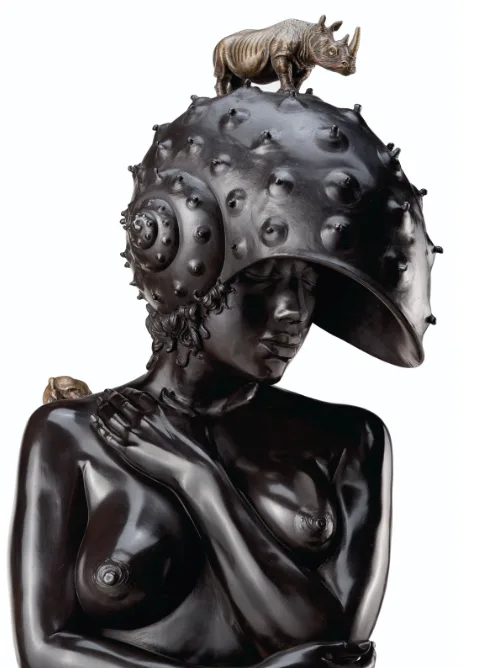
But the definitive example of what the market deems truly “spectacular” lies in his monumental sculptures. Take the bronze series “Rinocerontes Románticos”. When one of these nearly two-meter-tall giants comes to light, the narrative changes completely. At Christie’s New York, one of these titans doubled its high estimate to close at an impressive $437,500 USD—during a session where many other highly valued artists were left completely unsold. The rhinoceros is institutional iconography for Fabelo; it carries museum weight, and that is exactly why big money comes out to fight for it.
The real issue—the one driving the perception of a crisis—lies in the middle and lower tiers of his production. The secondary market became flooded with quick sketches, minor drawings, and medium-sized works that many bought out of pure speculation. Even with the Rhinoceroses, one must tread carefully: the 82-centimeter domestic versions play in a much more modest league (around $50,000 USD) and do not enjoy the same immunity as their larger siblings.
Now that buyers of minor works are trying to resell to find liquidity, they are hitting a wall of reality. Collectors have become exquisitely selective. They are no longer buying “the signature”; they demand the crowning achievement. If a piece feels run-of-the-mill or repetitive, they simply ignore it.
Is Fabelo’s market down? Yes, for anything that smells like filler or secondary formats. But for the serious collector, this reality check is actually good news. It cleans out the noise, cools down inflated prices, and reminds us that, even with the great masters, genius is not measured in bulk, but in exceptional pieces.




You May Also Like